Intermediate • aerodynamics • compressible • anderson • intermediate • core
Compressible Flow: Shocks, Expansions, and Supersonic Magic
Learning Objectives
- Calculate property jumps across normal shocks using the normal shock relations
- Solve the θ-β-M relation for oblique shocks on wedges and cones
- Use the Prandtl-Meyer function to find flow properties after an expansion fan
- Explain why shocks are irreversible (entropy increase) while Prandtl-Meyer expansions are isentropic
Core Explanation
Below roughly Mach 0.3, air behaves as if it has constant density. Once the flow approaches or exceeds the speed of sound, density changes become first-order effects and the entire character of the flow changes.
When supersonic flow encounters a compression (a wedge nose, a blunt body, an over-expanded nozzle lip), pressure information cannot propagate upstream faster than the speed of sound. The information 'piles up' into an extremely thin discontinuity — a shock wave. Across a normal shock, pressure, temperature, and density jump upward; velocity and Mach number drop; and, most importantly, total pressure is lost forever because entropy increases. The stronger the shock (higher upstream Mach or higher deflection), the greater the loss.
If the flow is instead turned away from itself (a convex corner), the gas can expand smoothly through a continuous fan of Mach waves — a Prandtl-Meyer expansion fan. Pressure, temperature, and density fall; velocity and Mach rise. Because the process is isentropic, total pressure is preserved. This is why well-designed supersonic inlets and rocket nozzles try to use isentropic compression or expansion wherever possible.
The θ-β-M relation governs attached oblique shocks: for a given Mach and deflection angle θ there is a shock angle β that satisfies the geometry and the Rankine-Hugoniot relations. Beyond a certain θ the shock detaches and becomes a strong normal shock standing in front of the body — with much higher losses.
In the Compressible Flow Lab you can switch between normal shock, oblique shock, and Prandtl-Meyer modes and watch p2/p1, M2, and entropy change update live. The same pressure ratios you create with a nozzle in the Nozzle Lab appear here as the flow structures around the vehicle in the atmosphere.
Visual Explanations
Diagram of a wedge in supersonic flow showing the oblique shock wave at angle β, flow deflected by θ after the shock, with regions labeled 1 (freestream) and 2 (post-shock).
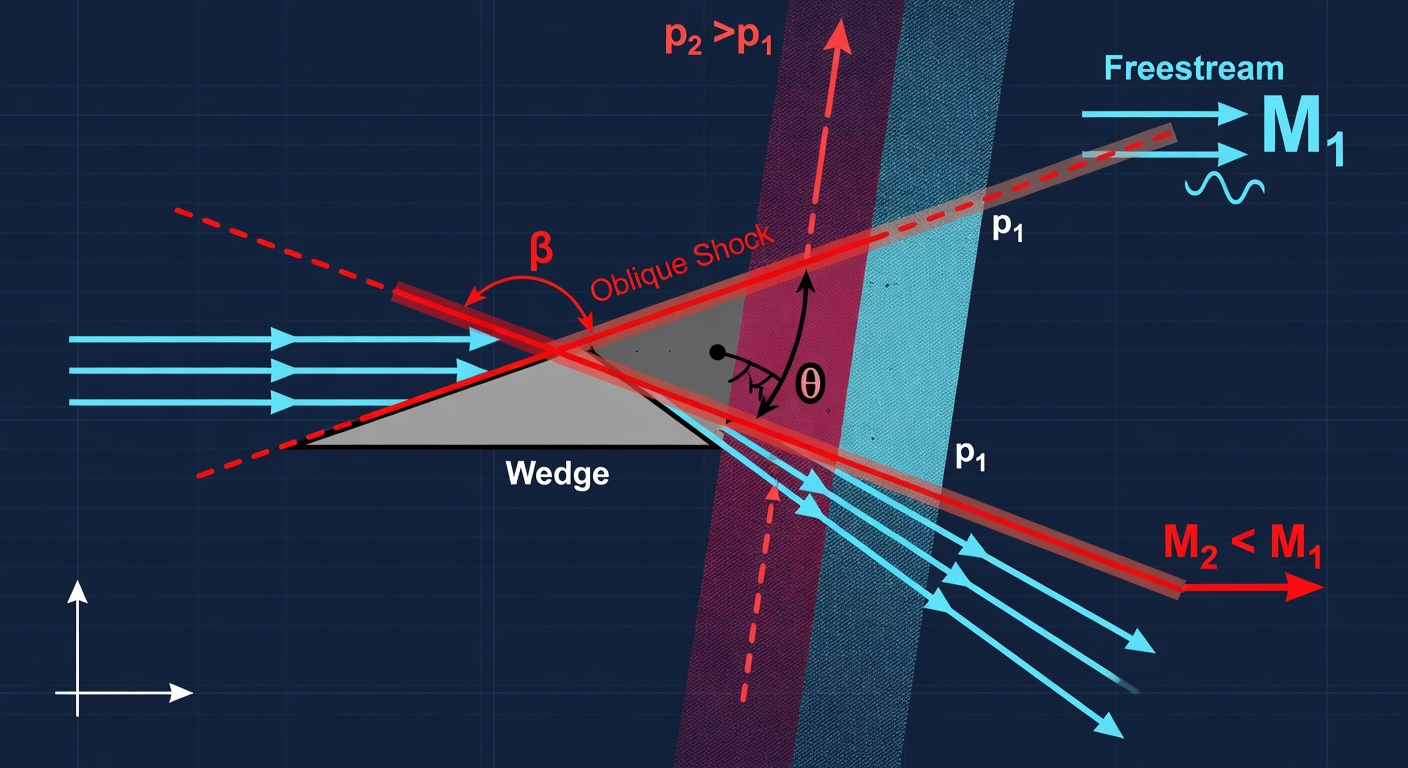
Engineering visualization
Convex corner with a fan of Mach waves (characteristic lines) spreading from the corner, flow turning gradually through the fan with increasing Mach number.
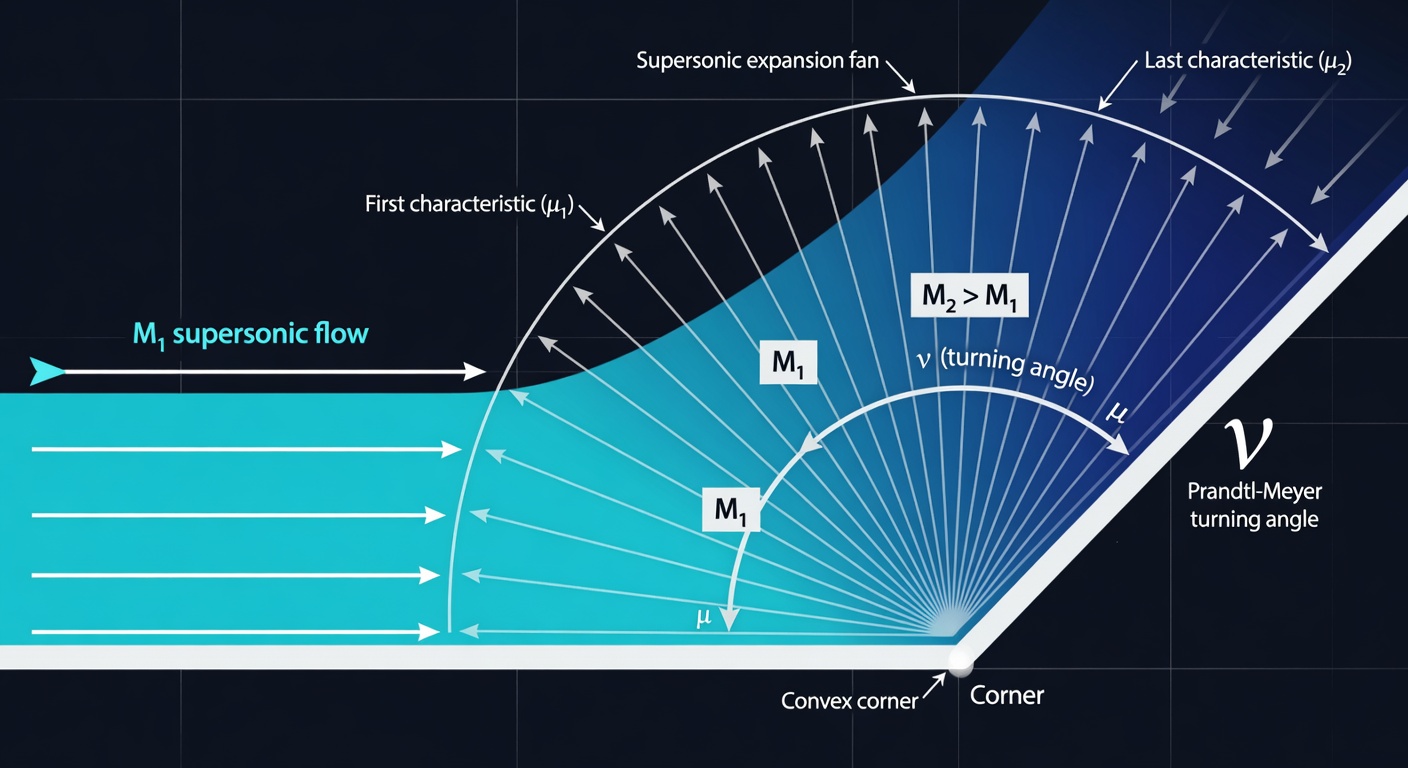
Engineering visualization
These diagrams were generated specifically to illustrate the concepts. Open the linked simulator to interact with the same physics in real time.
Interactive Exploration
Theory becomes intuition when you change the variables yourself. The simulator below implements the exact equations and flow physics described above.
Launch compressible flow Simulator →Try These Experiments in the Simulator
- Fix M1 = 2.0 and sweep wedge angle θ from 0° to 20°. Watch β increase and post-shock M2 drop. At some angle the attached solution disappears — the shock detaches.
- At the same M1, compare a normal shock (effectively θ = 0 but full normal) versus an oblique shock at θ = 10°. The oblique shock has a much smaller pressure jump and far less total pressure loss.
- Switch to Prandtl-Meyer mode. Increase the turning angle. M2 rises and pressure falls continuously and isentropically — no jump, no loss. This is the expansion that happens inside a properly designed over-expanded nozzle in vacuum or at altitude.
- Plot p2/p1 versus deflection. Notice how quickly the loss curve becomes punishing for strong shocks. This is why real supersonic inlets use multiple weak oblique shocks rather than one normal shock.
Return here after experimenting — the reflection questions will make more sense.
Common Misconceptions
- Shocks are just very loud sound waves — No. A normal shock is only a few mean free paths thick. It produces finite, irreversible jumps in all properties and a permanent loss of total pressure. Sound waves are isentropic to first order.
- You can expand or compress supersonically the same way — Compression through a shock is sudden and lossy. Expansion through a Prandtl-Meyer fan is gradual and lossless (isentropic). The two processes are not symmetric.
- All supersonic inlets just use shocks to slow the flow — Good ones use carefully designed multiple oblique shocks or near-isentropic compression surfaces precisely to avoid the huge total pressure loss of a single normal shock.
Real-World Connections
- The SR-71 Blackbird inlet used a translating spike and a complex system of oblique shocks to slow air from above Mach 3 down to subsonic for the engines while preserving as much total pressure as possible.
- First-stage rocket nozzles that are over-expanded at sea level (most boosters) contain oblique shocks and expansion fans inside or at the lip. These can cause flow separation, side loads, and reduced thrust until the vehicle climbs high enough for the nozzle to become ideally or under-expanded.
- Hypersonic wave-riders (X-43, proposed boost-glide vehicles) are shaped so that their own shock waves provide lift and compression. The vehicle 'rides' the shock it creates.
Reflection & Mini-Challenges
- For a given upstream Mach, is the total pressure loss higher for a normal shock or for an oblique shock that produces the same flow deflection? Why does the answer matter for inlet and nozzle design?
- Why are Prandtl-Meyer expansions fundamentally isentropic while shocks are not? What does that mean for the performance of a rocket nozzle that is over-expanded at sea level?
- A supersonic inlet designer must slow M = 2.5 air to M = 0.5 for the engine. Compare a single normal shock versus two oblique shocks followed by a terminal normal shock. Which has lower total pressure loss and why?
Animated Explanations
Shock vs Expansion: Compression vs Turning Away
Side-by-side animation of flow hitting a wedge (shock) vs turning around a corner (expansion fan), showing property changes.
Full motion visualization planned for future updates. The static diagrams and live simulators above cover the core dynamics today.
Next Steps
- → In the Nozzle Theory Lab, set a high expansion ratio and sea-level ambient pressure. Watch the visual over-expanded plume and mentally map the internal oblique shocks and separation you are seeing onto the diagrams in this lesson.
- → In Rocket Forge, design a hypersonic first stage or a reentry vehicle. The wave drag and pressure coefficients coming out of the compressible lab become real contributions to your vehicle’s Cd and heating.
- → Explore staging at high altitude in Forge. Once you are above most of the atmosphere you can use much higher-ε nozzles without paying the over-expansion penalty at sea level — exactly because the ambient pressure that drives the shock losses has dropped.