Intermediate • propulsion • nozzle • sutton • intermediate • core
Nozzle Theory: Turning Heat into Speed
Learning Objectives
- Understand how a converging-diverging nozzle converts thermal energy into directed kinetic energy
- Derive and apply the area-Mach relation for isentropic flow
- Calculate thrust coefficient (CF) and specific impulse (Isp) from first principles
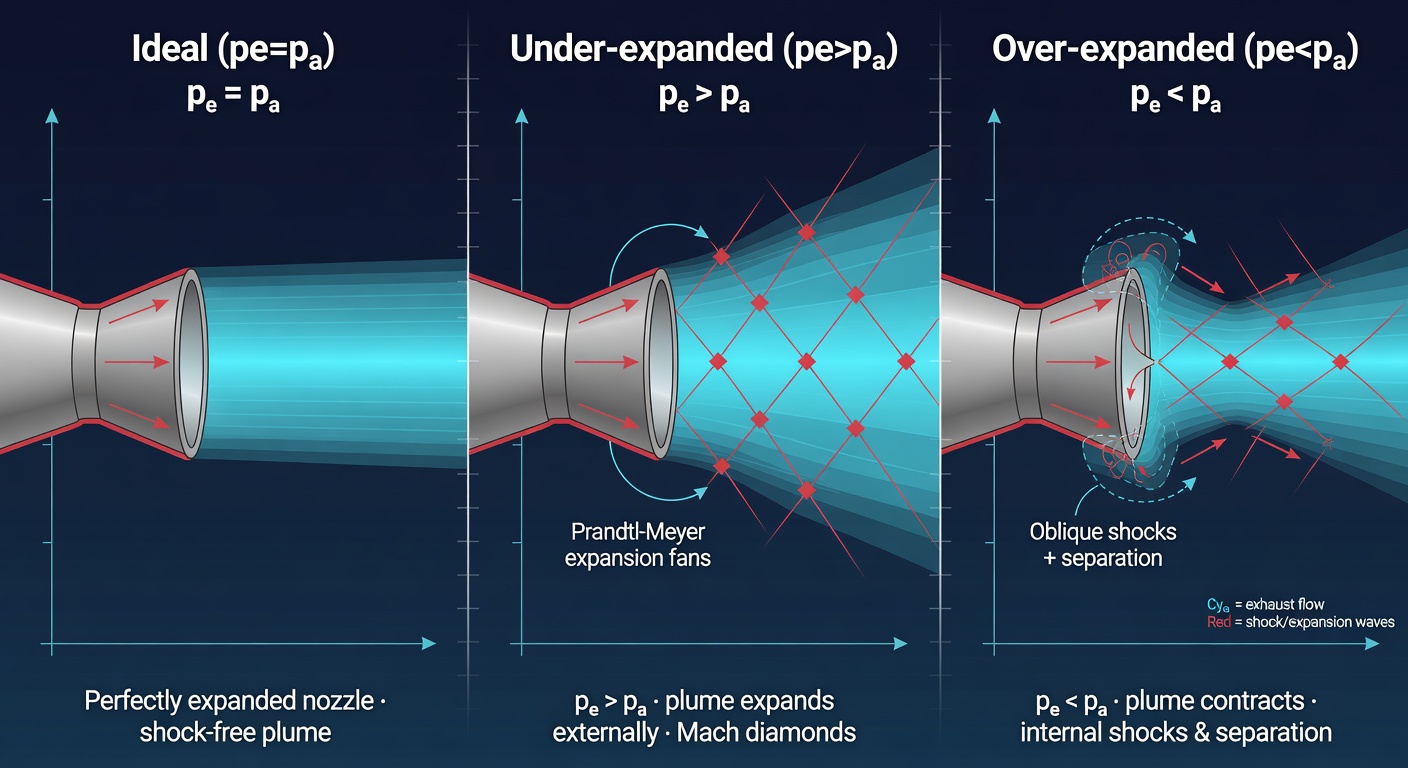
- Classify nozzle flow regimes (ideal, under-, over-expanded) and their effects on performance
- Design an optimum expansion ratio for a target altitude
Core Explanation
A rocket nozzle is the most elegant thermodynamic machine ever built. It takes random, high-pressure, high-temperature gas motion inside the combustion chamber and turns it into an orderly, hypersonic beam of gas pointed exactly backward.
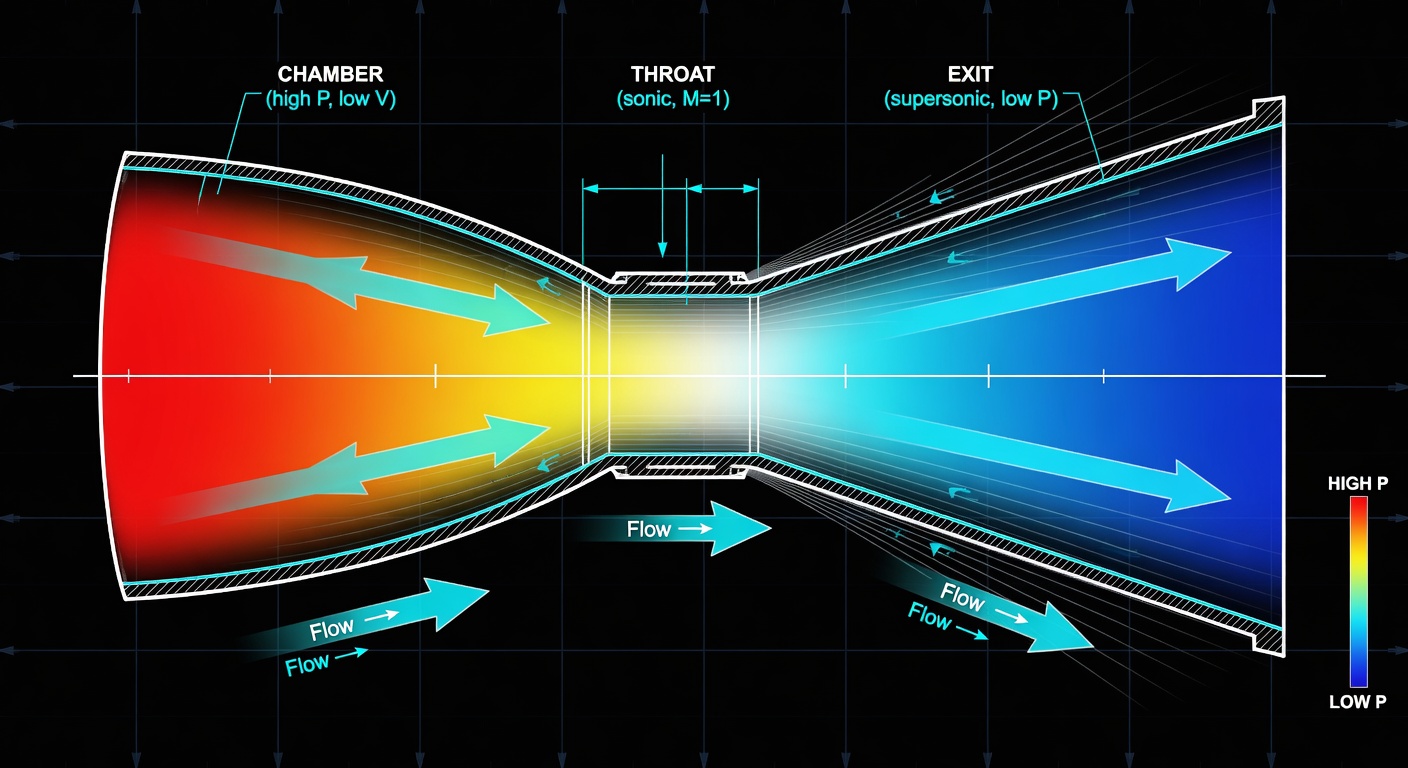
Start with the converging section. As the gas flows into a narrowing duct, it accelerates. By the time it reaches the narrowest point—the throat—it is traveling at the local speed of sound (Mach 1). This is called choked flow. Once the flow is sonic at the throat, further increases in chamber pressure do not increase the mass flow rate; the throat is the bottleneck.
In the diverging section the magic really happens. The area increases and the gas expands. Because the flow is already supersonic, expansion lowers the pressure and temperature while dramatically increasing velocity. The area ratio ε = Ae / At (exit area over throat area) directly sets the exit Mach number via the isentropic area-Mach relation:
A/A* = (1/M) * [ (1 + ((γ-1)/2)M²) / ((γ+1)/2) ] ^ ((γ+1)/(2(γ-1)))
This is why vacuum-optimized engines have enormous bells (high ε) and sea-level boosters have shorter, stubbier nozzles (low-to-moderate ε).
Thrust comes from two sources: the momentum of the exhaust (ṁ * ve) plus the pressure imbalance at the exit plane ( (pe − pa) * Ae ). The thrust coefficient CF packages these effects into a single non-dimensional number that you can measure directly in the Nozzle Lab. Higher CF at a given ambient pressure means better nozzle design for that altitude.
The simulator lets you watch all of this in real time: change pc, γ, or ε and see Mach, pressure, temperature, and the three Isp values (vacuum, sea-level, and instantaneous) update instantly along with the visual plume regime.
Visual Explanations
Labeled cross-section of a de Laval nozzle showing converging, throat, diverging sections with flow arrows, Mach number increasing, pressure dropping.
Engineering visualization
Three side-by-side diagrams: ideally expanded (straight plume), under-expanded (plume flares out with expansion waves), over-expanded (plume pinched with oblique shocks and separation).
Engineering visualization
These diagrams were generated specifically to illustrate the concepts. Open the linked simulator to interact with the same physics in real time.
Interactive Exploration
Theory becomes intuition when you change the variables yourself. The simulator below implements the exact equations and flow physics described above.
Launch nozzle theory Simulator →Try These Experiments in the Simulator
- Set sea level ambient (pa=1 bar) and increase ε from 5 to 50. Notice how Isp_sl peaks then drops while Isp_vac keeps rising — this is the expansion ratio trade-off in one graph.
- Switch to vacuum (pa=0) and observe the plume always under-expands. There is never a penalty for a bigger bell in space.
- Try different propellants (change gamma and mol wt) and see the direct effect on c* (characteristic velocity) and Isp. Hotter, lighter gas wins.
- Look at the property distribution plot: watch how fast Mach rises once the flow passes the throat. The acceleration is astonishing in the first 20% of the bell.
Return here after experimenting — the reflection questions will make more sense.
Common Misconceptions
- Bigger nozzle is always better — No. Over-expansion at low altitude causes oblique shocks inside or at the lip, flow separation, side loads, and a measurable drop in thrust coefficient.
- The nozzle 'squeezes' the gas to make it faster — Partially true only in the converging section. The real supersonic acceleration happens through expansion (pressure drop) in the diverging bell.
- Rockets need air to push against — Completely false. They achieve their highest performance in vacuum. The nozzle pushes on the gas; by Newton’s third law the gas pushes the rocket forward.
Real-World Connections
- SpaceX Merlin 1D sea-level nozzles use ε ≈ 16. The vacuum variant on the upper stage uses a much larger bell (ε ≈ 165) optimized only for space.
- The Space Shuttle Main Engine had one of the highest expansion ratios ever flown on a booster engine (ε ≈ 77.5). It was spectacular in vacuum but suffered significant performance loss and even flow separation risks if the nozzle had been used at sea level.
- Nozzle design is why first-stage engines look short and fat while upper-stage and spacecraft engines have giant, delicate-looking bells.
Reflection & Mini-Challenges
- If you are designing a booster that flies through sea level to 60 km, what single expansion ratio would you pick and why? What trade-offs between sea-level performance and high-altitude Isp are you accepting?
- Why does the area-Mach relation predict that you can never reach supersonic speeds in a purely converging nozzle, no matter how high the chamber pressure?
- In the lab, what happens to exit pressure pe as you increase ε at fixed pc? How does that directly cause the visual change from ideal → under-expanded plume?
Animated Explanations
How a de Laval Nozzle Works
30-45 second animation showing gas particles accelerating through converging-diverging nozzle, color coded by speed and temperature.
Full motion visualization planned for future updates. The static diagrams and live simulators above cover the core dynamics today.
Next Steps
- → Take the Isp and CF values you measured in the lab and plug them straight into a single-stage configuration in Rocket Forge. Watch how a 10-second change in Isp changes your payload to orbit estimate.
- → Go to the Compressible Flow Lab and reproduce the same pressure ratios you just created with the nozzle as oblique shocks and expansion fans on wedges — the physics is identical.
- → In Rocket Forge, design a two-stage vehicle. Give the booster a modest ε (good sea-level CF) and the upper stage a very high ε. Observe the dramatic jump in total Δv compared with using one compromise nozzle.